
Our Cattle Analysis
-
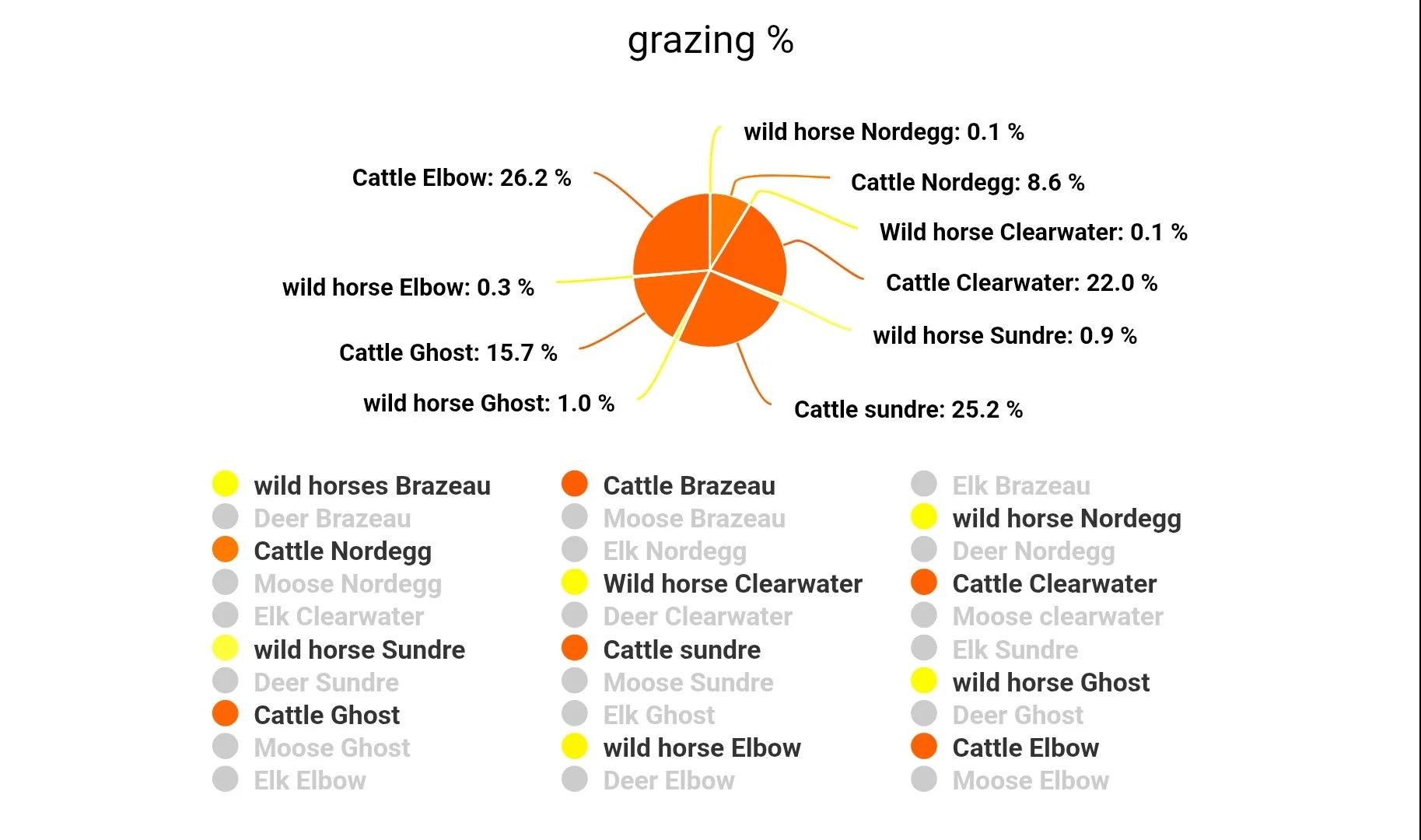
Cattle vs Wild horse population percentages
While we made a graph for the overall data for the eastern slopes as a whole on the grazer population percentage research page, then we did the 2013-2025 large grazer species breakdown.
now we are looking at pie data between cattle and wild horses, and how each population compares to the other in each zone. Yellow is the wild horses, orange is the cattle in this pie graph. While wild horses remain under 1% of grazing species, Cattle fall between 8%-30% of the total large grazing species in the eastern slopes. Here is an example. If 30 people start a fight, get in trouble, and the 1 bystander is blamed for the fight, well that, is exactly what we are seeing here, while it is not an exact comparison, it gives us an example of what kind of science we are looking at. Cattle making up 30% of the grazing species, brings in more profit than the wild horses the natural species, so we blame the 1% population vs the 30% population due to the profit the 30% population brings in through beef. And leases.
So while cattle are not the whole problem, they are a huge part of the problem.
Let’s talks about a few reasons the cattle leases are so dangerous for the wild horses.
To understand this we have to understand how cattle leases work, with a few main ways we see cattle leases occur, 1st the government auctions off a piece of land to the highest bidder, for a 10-75 year lease (more or less). Stocking levels are decided by the “AUM” this is the ‘animal unit month’ They base this off of a 920lb cow and an 80lb calf. This can also be stated as 1000lb cow with or without a calf up to 6 months old, most calves hit the lease at 1 -5 months old staying on the lease till they’re up to 7-8 months old. This estimates a “cow calf pair” eats about 26lb of forage per day. Times that by 30 days and you get the AUM, by this outdated standard it is roughly 800lb of forage. Why this “science” is already starting off on a faulty factor. In Alberta the majority of cattle grazed on leases are Angus or Angus mixes. An Angus cow in the modern day, weigh between 1000-1400lb (20-380lb difference) plus. Calves typically only weigh 60-90lb as newborns. By one month old calves are 100-150 lb + meaning the calculations and factors used are inaccurate at best. This may have worked when it was originally created, but with breeding programs and only the best stock held back, 900-1000lb cows are simply not the standard anymore. Meaning for every cow calf pair that is calculated they calculate based on a new born calf and an underweight cow. We also have to note calves are on this land often into August -October. In Alberta most calves are born between February-April.
Cattle leases open up for the season typically between may-june lasting till usually between the end of August to as late as October. This means, by the time the cattle hit the leases, the calves are already roughly 1-5 months old by the time the hit the lease. We’ll over the 80lb AU (animal unit) given to them. By the time the calves wean they can weigh between 400-700lb, by the time October comes, they are all well over 300lb
So here is where the stays come in, if you are following along. If we average out the cow weight knowing between 1300-1400 lb is the standard, with Alberta lush pastures and meadows we will average them around 1300lb. Then we have the calves starting on the lease around 100-150lb and ending their time on the lease at 400-700lb if we average the cow down to 1300lb and the calves down to 300lb we get a total of 1600lb. Meaning the government’s standard 1 AU for 1 cow calf pair, is really 1.6 AU for 1 cow calf pair
In data terms this means every month the leased cattle are eating 60% more than what their stocking levels are. So if they stock the levels at the max they are really around 60% over max stocked every month on every lease. This also technically means that the government is giving a 69% off deal to ever leaser for every cow calf pair. If the government wants to worry about profit..maybe updating the AUM would actually benefit them, while also reducing overstocked cattle leases..Just a thought.
What can help this? Updating the AUM in Alberta from the 1 AUM of 920lb cows to the 2025 modern day AUM of 1300-1400lb cows and 150-700lb calves roughly a 1.4 - 1.6 AUM. It would not removed cattle but it would definitely fix the over grazing issues. Let’s not blame wild horses for outdated science not accounting for selected breeding to increase cattle weights. Which is the true culprit for any over grazed meadows. I will state again because I believe it is so important to understand that if you see damage caused by wild horses, scan a 1km radius and I am sure you will find a salt block. We have more studies on the salt blocks coming soon. They are what make wild horses stop migrating, we need them to keep moving and migrating for their safety and for the overall ecosystem health.
Now lets look at the next issue regarding cattle. When we went through internet archives, auction archives, manifests, settlements, we found a common reoccurring theme. Cattle leases have very high wild horse removal rates. I was curious about this, so I dove deep into data and studies finding all that I could find and I figure it comes down to a few things but while I am on the topic of AUMs already, I will start here. When stock levels and lease prices are decided it is based on the outdated AUM of 1 cow calf pairs = 1 AUM based on what we know this should really be around 1.4 animal units or 1.6 AU for every cow calf pair. At least. Or have it change every month based on calf weight averages for that month, there’s an idea.
So if we go by what the government uses for stocking levels even though we have proven it does not fit the Alberta modern cattle the AUM in Alberta works out to be $9.94 a month per cow calf pair, some areas its lower sitting just under $7 per AUM. Based on their data, this means ranchers are paying between $6.97 - $9.94 for every 800 lb of grass their cow calf pairs eat and take off the crown land. If we go with what we know on average a cow calf pair weighs giving 1300lb to the cow and 300lb to the calf at 1.6 AUM the cattle leasers (in today’s market economy) should really be paying between $11.15- $15.90 per AUM (cow calf pair month of forage). So not only is the government 60% of grass for free, the cattle ranchers get a 60% discount and the cattle are then 60% overstocked. A huge chain reaction for having the weights out dated ..right?
Now we have to look at why this has such a huge impact on the Alberta wild horses. Little did we know that cattle ranchers have the right to pick and choose what species can grass on the crown land lease they rent. And with every cattle rancher paying $7-$10 dollars per cow calf pair, every wild horse they see is forage they essentially “pay for in their lease” for their cattle to eat, they lease the grass and pay for their cattle to eat the grass. Any other species on the land that eats forage is forage money lost for the cattle ranchers. If cattle ranchers do not like sharing the lease of crown land with the other species, they simply should not lease land in the Alberta wilderness. There are land leases and sales all over the province. If you choose to purchase a lease in wild horse country. You should have to accept that they are part of the landscape and ecosystem they are not a loss to your forage lease. Cattle ranchers feel entitled to the land due to their lease. This needs to end. It is not owned land. It is crown land. Indigenous land. Those who pay to lease it should not get to decide what species are allowed on “their lease”. That’s the next issue.
In our wild horse research we found that these cattle leasers are legally allowed to call in wild horses for “forage competition” having the wild horses removed off the rented crown land wilderness because they “compete with the cattle for forage” how can we remove in a non native species in numbers like 60,000 and then blame 1500 wild horses for …forage competition?
This is the crooked way things are in the eastern slopes. Cattle leasers can have wild horses rounded up by the dozens. Who needs to cull them when the cattle leasers can essentially and effectively have every wild horse removed on these “forage competition” grounds. Then add in the “nuisance” calls where ranchers leave their gates open, wild horses show up, the gates get shut and private sales commence, completely private or through the LIS strays act. And yes some of these “ private cattle leasers” have left paper trails enough to know what cattle leases these wild horses came off of, having the land locations and ranges the wild horses were capture d on or removed from many cattle leases who are adjacent to crown land have removals yearly some years we see 10-20 removed with paper trails off crown land emz or off bordering lands.
The biggest surprise to us of all on this was that cattle leasers can call in a wild species for forage competition. Having wild horses removed for competing with their livestock on crown land. We do not see anyone coming to bat for the wild horses saying the cattle need to be removed for forage competition they outcompete the caribou moose and elk too. But clearly cattle populations are allowed to thrive in the tens of thousand on alberta mountain wilderness land while the less than 2000 wild horses are blamed for damage. A backwards system to say the least, is what we see here.
Then we add on top of that a program I just learnt about, which essentially gives certain groups the right to put capture pens on cattle lease land to essentially help the cattle leasers remove the wild horses. A partnership. They are all over the place. And we have confirmed 3 leases on crown land have been “closed to the public” from April 2025- April 2026? What are they doing on these three leases that would need total privacy? Enough privacy they needed to ban human presence and recreation…we are looking further into this and will have some field research coming to see what we find on why these three leases on public land were closed to the public. Knowing what we know, and the capture program restarting this year under a non-disclosure type agreement this is happening right in front of our eyes. With 70 removed pre MUI (non disclosure) can you imagine how many might be removed now under their confidentiality agreement? The government now blankets these capture and cull groups with legal secrecy.
What benefit do cattle ranchers gain from removing wild horses , apart from the last stated AUM costs associated with forage costs.
Well here’s where it gets a little silly and in the chaos of it all you really just have to shake your head.
Cattle ranchers are paid back when they capture a wild horse or report a wild horse, if enough money is paid at auction for the wild horse, the cattle rancher is paid back for the AUM of the wild horses that were on his or her lease, they get paid for any costs associated with capturing, containing or holding the wild horses on their lease or ranch. And if they take it to auction they get paid for any fuel or other expenses accumulating from bringing the wild horses to auction. So they remove a species from the land get more
grass for their cattle, get paid for the grass the wild horse ate, and get paid for any time and expenses associated with capturing and holding the wild horse . LIS makes it a “rescue” “forage competition” “nuisance removals” or just “a stray” when the Auction date comes. The ranchers have everything to gain for removing the wild horses, they are financially incentivized to remove the wild horses. So while we could blame the ranchers, It really wouldn’t make a difference why? Because they are doing exactly what the government authorized them to do, the only way to stop this is to stop ALL captures. Capture licenses and private rancher captures. No incentives should be provided for removing a species from Alberta crown land wilderness.
Now here is where things get even trickier. The lands health is decided by Agrologists. They go into the range lands, crown land, and cattle leases, they measure the land, grass ,and forage, the look for weeds, bare soil and other signs of erosion or land degradation. In the Agrologist rangeland handbook, agrologists are warned not to survey densely populated areas or “sacrificial areas” this can be chalked up to water troughs and salt blocks. So if the rangeland Agrologists are surveying around salt blocks to decide the wild horse damage, they are breaking their own assessment guidelines. They are only supposed to survey and judge around salt block and sacrifice areas unless they intentionally looking for a study in that sacrifice area. While a sacrifice area, by definition is a little different, it still considers salt blocks a form of sacrificial area, in the rangeland assessments we can see the majority of the damage was chalked up to OHVs and cattle, one area mentioned erosion due ti wild horses, but you know what else it said “(bait)” meaning the only place the Agrologist found damage from wild horses was in fact around a bait stations. As we all know this is term for salt block stations. Proving yet again that the salt blocks cause more damage than the wild horses. And on the Agrologist report the damage should have been listed as salt block sacrilege area damage, not wild horse damage with bait.
And finally. The biggest tell of all on why Agrologist reports may not be 100 accurate this is a chain and cylce effect at play. Every lease is managed by a rangeland Agrologist. They are designated and picked by and through the ministry of Forestry and Parks. Agrologists are funded by the “Rangeland sustainability program” this program if funded and paid for by cattle lease and AUM fees. Essentially if the Agrologists say the land is eroded they either remove cattle (which is their income) or the find something else to remove. The wild horses. If we want Agrologists to give an accurate unbiased opinion they should be funded by something other than the cattle leases (which are the main area we should he looking at with land erosion..and deer). A pay to play type system where cattle leassrs get to decide which animals can graze in the eastern slopes on the crown land they lease. Cue in the feral horse management framework….. a board filled with conflicting interests. Those who profit from removing wild horses through capture licenses and those who profit off the removal of wild horses due to increased cattle head. Should this not be filled with those who have no financial gain in the taking of wild horses? Of is this not deemed a conflict of interest?
The 5% pf sites deemed below healthy in the eastern slopes, when weed related, are often over run by tall butter cup and Canada thistle.
Wild horses almost never eat Canada thistle or tall butter cup. Tall butter cup is toxic and thistle is unpalatable to wild horses, yes wild horses spread seeds, but only the seeds in their diet.
So we dove into Canada thistle and butter cup. 4 species have been known to like and eat thistle, while occasionally eating young green tall buttercups. This is Mountain goats, mountain sheep, deer and moose. While wild horses cattle and elk prefer not to touch these weeds. Cattle will eat thistle from time to time, for the most part, most grazing species avoid these two plants, and spread can be attributed mainly to birds. So what could we do to lower noxious weeds like butter cup and thistle? 1 increase mountain sheep as a natural control method, they like to eat green butter cup and thistle before they seed, lowering seed spreading. And second, we have hundred of people in the back country planting trees for the forestry cut blocks. The best method for controlling tall butter cup is hand pulling it before it turns to seed. We could have those out planting seeds, actively controlling noxious weeds, by hand pulling along their tree planting paths. If Agrologists see a wild horse near an over grazed meadows or a high noxious weed sight, the can attribute this to the wild horses, even if the wild horse was simply passing through the area when the Agrologist spot them. Essentially wrong place wrong time, for the wild horses.
We have a lot more to dive into regarding the cattle leases, we will end here for our general intro into the cattle analysis and pick up in part 2. Thanks for reading, we hope this helps everyone see the data laid out, the weak points noted and the good areas highlighted. Lets continue to look at the whole picture to see what links we find along the way. See you in our next research segment